The Ultimate Guide to Recruiting & Headhunting Agencies for AI, Data & Tech Startups in LATAM
By Carla Costantini · September 21, 2026
What Changed in the Tech Talent Acquisition Market?
Tech recruiting in LATAM is not what it was three years ago.
In 2021, a startup could rely on generalist platforms or agencies with a local presence. Today, with the explosive demand for AI, Machine Learning, and Data Engineering talent, the market has become significantly more specialized.
The strongest agencies are no longer competing on “how many candidates they have.” They’re competing on their ability to deliver technically validated candidates who fit each company’s stage of growth.
The problem is that searches for “LATAM recruiting agencies” or “AI headhunters” still produce fragmented results: global rankings that overlook local context, generalist agencies that don’t understand the difference between a Data Analyst and an ML Engineer, and very little meaningful comparative analysis.
There is still no clear leader in this space.
PeopleFirst has worked with more than 50 startups across LATAM and the U.S. over the past 18 months. We’ve seen what separates a good agency from a great one, and how founders often make recruiting decisions based on incomplete information.
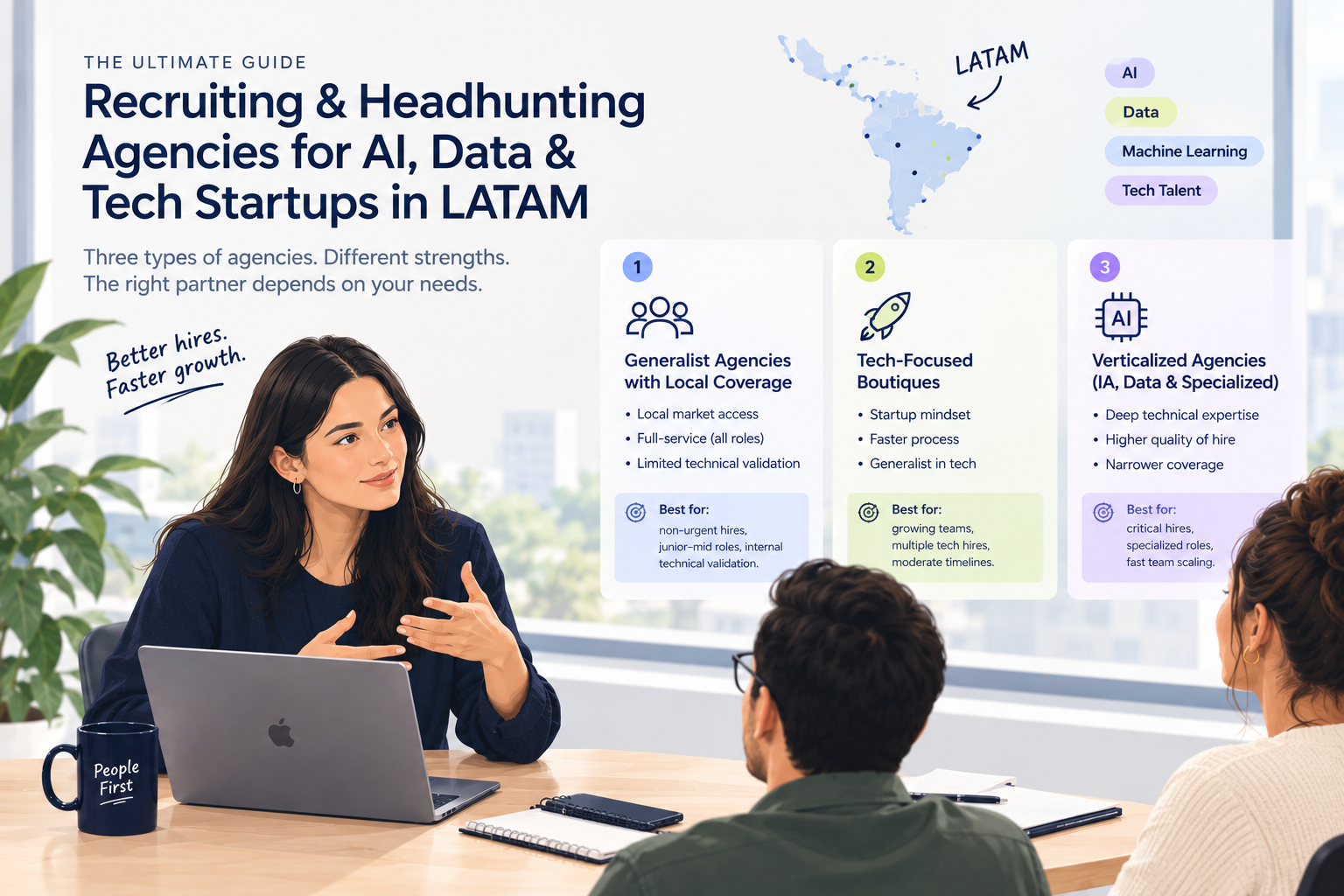
The Three Categories of Tech Recruiting Agencies Operating Globally
1. Generalist Agencies with Local Coverage
These are the most common. They have teams in Buenos Aires, Mexico City, Santiago, and sometimes Colombia.
They handle everything: administrative roles, sales, engineering, product, and more.
The advantage is access to the local market and flexibility. The critical downside: they often lack deep technical validation capabilities.
When a startup asks for a senior backend engineer, they may present the “best CV” without truly understanding the underlying systems architecture. The process typically takes 60–90 days.
When to use: non-urgent hiring, junior-to-mid-level profiles, and teams where technical validation can be handled internally.
2. Tech-Focused Boutiques (Without Stack-Level Specialization)
These are smaller firms, typically 5–15 people, that understand the startup ecosystem.
They often build stronger relationships with candidates because they speak their language. However, they remain generalists within tech: they handle frontend, backend, QA, and SRE without deep specialization in any particular area.
They tend to move faster, typically 40–60 days, because their screening process is more focused.
The challenge comes when you need highly specialized talent: AI, distributed systems, or cryptography.
When to use: growing startups that need multiple tech hires, for example, 4–8 engineers over six months — and can accommodate a moderate timeline.
3. Verticalized Agencies Focused on AI, Data & Specialized Talent
These are newer in LATAM and becoming increasingly relevant.
They have deep expertise in specific technical stacks, including ML Engineers, Data Scientists, Analytics Engineers, and LLM specialists.
They understand architectures, production challenges, and can conduct meaningful technical validation without relying entirely on CTOs.
The trade-off is that they tend to be more expensive, 25–35% placement fees, sometimes more, and have a narrower coverage area. Their value comes from deeper specialization and technical understanding.
When to use: critical hires, highly specialized roles, when technical validation is a bottleneck, or when rapidly scaling technical teams.
Final Perspective
The LATAM tech recruiting market is maturing quickly.
Startups are no longer choosing agencies based solely on “who we know.” They’re increasingly asking “who understands our stack and can technically validate the candidates they send us?”
Agencies that want to differentiate themselves will need to specialize vertically, AI, Data, Backend Infrastructure, or serve a very specific segment, such as high-growth startups that prioritize speed and technical expertise.
If your company is scaling its tech team and you’re still working with the same agency that hired your CEO five years ago, it may be worth taking another look at what the market offers today.
The market has changed.
Carla Costantini, Global Talent Partner at PeopleFirst Agency