The Myth of Remote-First in Tech: What LinkedIn Says vs. What the Market Says
By Carla Costantini · September 28, 2026
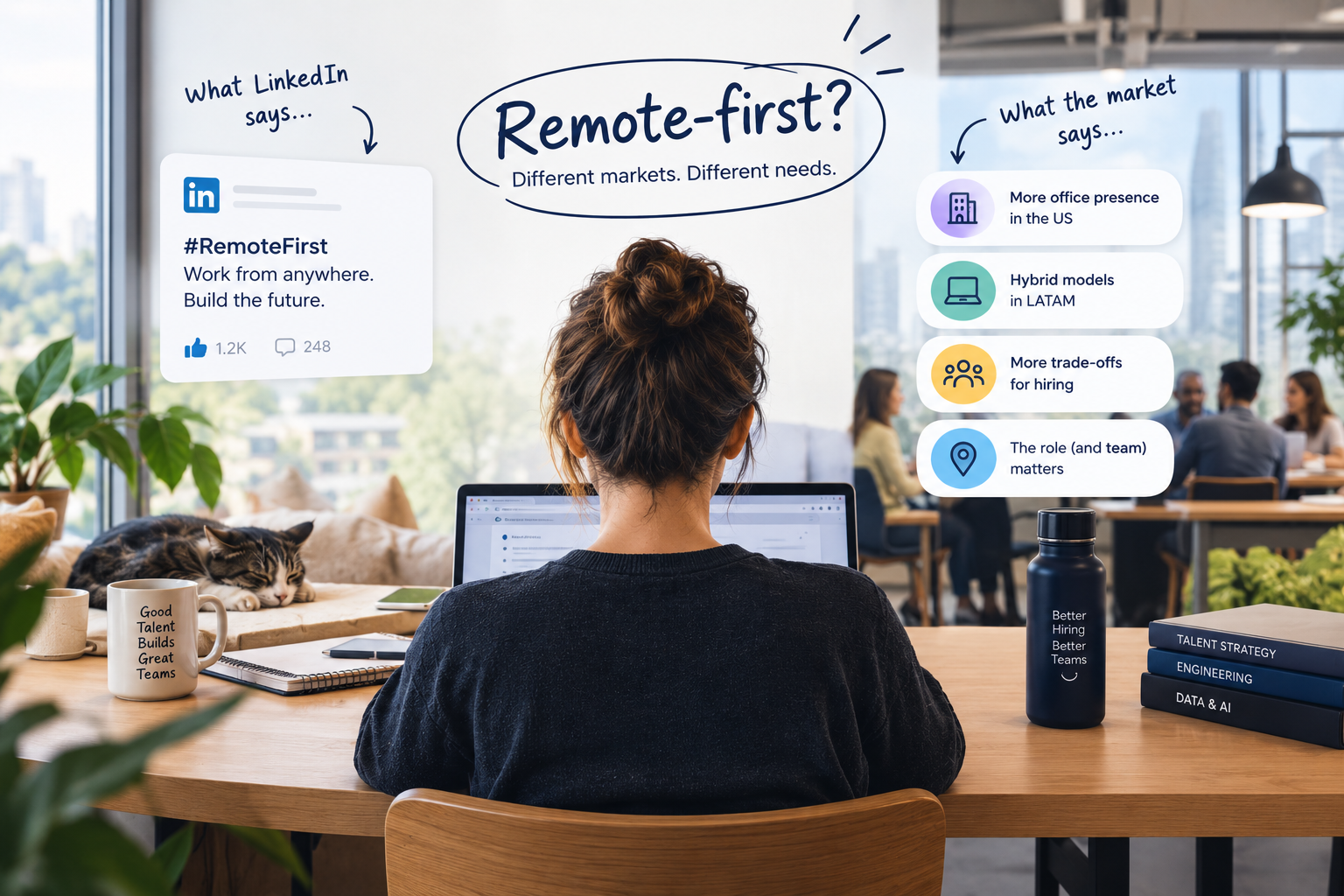
“Remote-first” is still everywhere on LinkedIn.
But if you look at what companies are actually offering, the picture is becoming much more nuanced.
Remote work existed in tech long before the pandemic, especially in engineering teams used to working across countries and time zones. What changed after 2020 wasn’t the existence of remote work — it was how widely companies were willing to offer it.
Today, the market seems to be moving in different directions depending on the company, the role, and the region.
Two Markets, Two Speeds
In the US, many startups and scaleups have been moving toward more office-based models. Some are going back to fully on-site environments, while others are introducing hybrid models with several days per week in the office.
In LATAM, the shift has generally been more gradual.
Hybrid models remain common, with companies often combining two or three office days with remote work. There is still more flexibility than in many US-based companies, but less than there was a few years ago.
The result is not a simple move from remote to office.
It’s a market with different speeds, different expectations, and increasingly role-specific policies.
Why Companies Are Pushing People Back to the Office
The arguments are familiar:
- Culture and team cohesion
- Faster collaboration and problem-solving
- Knowledge sharing
- Onboarding and learning
- Retention and connection
- Easier coordination across teams
For some companies, being together in person is seen as a way to improve how teams operate.
And there are situations where physical proximity can genuinely make certain things easier: resolving complex problems, transferring knowledge, building relationships, or getting a new team member up to speed.
But there is another side to the equation.
Flexibility Expands the Talent Pool
Every additional office requirement changes the candidate pool.
A company asking for five days in the office is competing for a very different group of candidates than one offering fully remote work.
And this becomes even more relevant for senior and highly specialized talent.
The right candidate might live in another city. Or another country.
They might already have a setup that works extremely well for them. They might not be willing to relocate — or accept a long commute — simply because a company decided that everyone should be in the office.
So the question isn’t only:
“What work model do we prefer?”
It’s also:
“What talent are we willing to exclude because of that decision?”
Office Presence Can Solve Some Problems — But Creates Others
There is a real trade-off here.
More in-person interaction can help with collaboration, culture, and certain types of knowledge transfer.
But less flexibility can also mean:
- A smaller talent pool
- More geographic restrictions
- Longer hiring timelines
- More difficulty hiring specialized profiles
- Candidates dropping out of processes because of location requirements
For companies hiring in competitive tech markets, the work model is part of the hiring strategy.
It directly affects who enters your funnel in the first place.
The Role Should Influence the Model
One of the biggest mistakes is treating the work model as a company-wide decision that applies equally to every role.
But not every role operates in the same way.
A senior engineer working independently across a distributed team may have very different needs from a junior employee who requires intensive onboarding and mentorship.
A highly collaborative Product role may benefit from more in-person interaction than a deeply focused individual contributor role.
The right question may not be:
“Are we remote-first or office-first?”
It may be:
“What working model allows this specific team to perform at its best — while still giving us access to the talent we need?”
That distinction matters.
The Real Cost of “Just One More Office Day”
From a hiring perspective, an extra office day might seem like a small change.
But candidates don't experience it in isolation.
One additional day can mean:
- A longer commute
- Higher transportation costs
- Less flexibility
- Different childcare or family logistics
- Being unable to apply from another location
And for a candidate who has multiple opportunities, those details can influence whether they enter or stay in a hiring process.
The work model is part of the candidate experience.
It can influence both attraction and retention.
So, Is Remote-First Disappearing?
Not necessarily.
What seems to be changing is the idea that one model works for everyone.
Some companies are moving toward more office presence. Others remain fully remote. Many are landing somewhere in between.
And candidates are adapting too.
For hiring teams, the important thing is to understand the trade-off instead of treating remote vs. office as an ideological debate.
More office presence may support certain cultural or collaboration goals. More flexibility may expand access to talent.
Neither decision exists in a vacuum.
The real question is whether your hiring strategy is aligned with the talent you actually need to attract.
At PeopleFirst, we help companies think about work models not just as an internal policy, but as part of their talent strategy — especially when hiring Engineering, Data, and AI profiles across LATAM, the US, and Europe.
Carla Costantini, Global Talent Partner at PeopleFirst Talent Partners