How to Scale an AI and Data Team in 90 Days: A Playbook for Series A–B Startups Hiring in LATAM and USA
By Carla Costantini · October 19, 2026
You just closed your round. The board wants to see execution, the roadmap has AI features already committed, and your current engineering team is stretched thin. Now you need to hire 5 to 10 Data and AI people in a single quarter.
Most startups that try this end up in one of two places: they hire fast and badly, or they hire well but so slowly that the roadmap slips anyway. This playbook is designed to avoid both.
Before opening a single role: week 0
The most expensive mistake when scaling doesn't happen in interviews. It happens earlier, when roles are opened without clarity on what problem each one solves.
Before posting anything, answer these three questions with your leadership team:
- What needs to be working in 6 months? Not "have an AI team," but something concrete: a scoring model in production, a reliable data pipeline, an LLM-powered feature used by real customers.
- What is infrastructure and what is product? If your data isn't clean and centralized, no ML Engineer will be able to deliver value. Very often, your first "AI" hire needs to be a Data Engineer.
- Who will lead technically? Hiring five people without a technical lead who sets standards means hiring five different ways of doing things.
Order matters: how to sequence your hires
Not every search has to start on the same day. Opening them all at once overloads your interviewers and lowers the quality of your decisions.
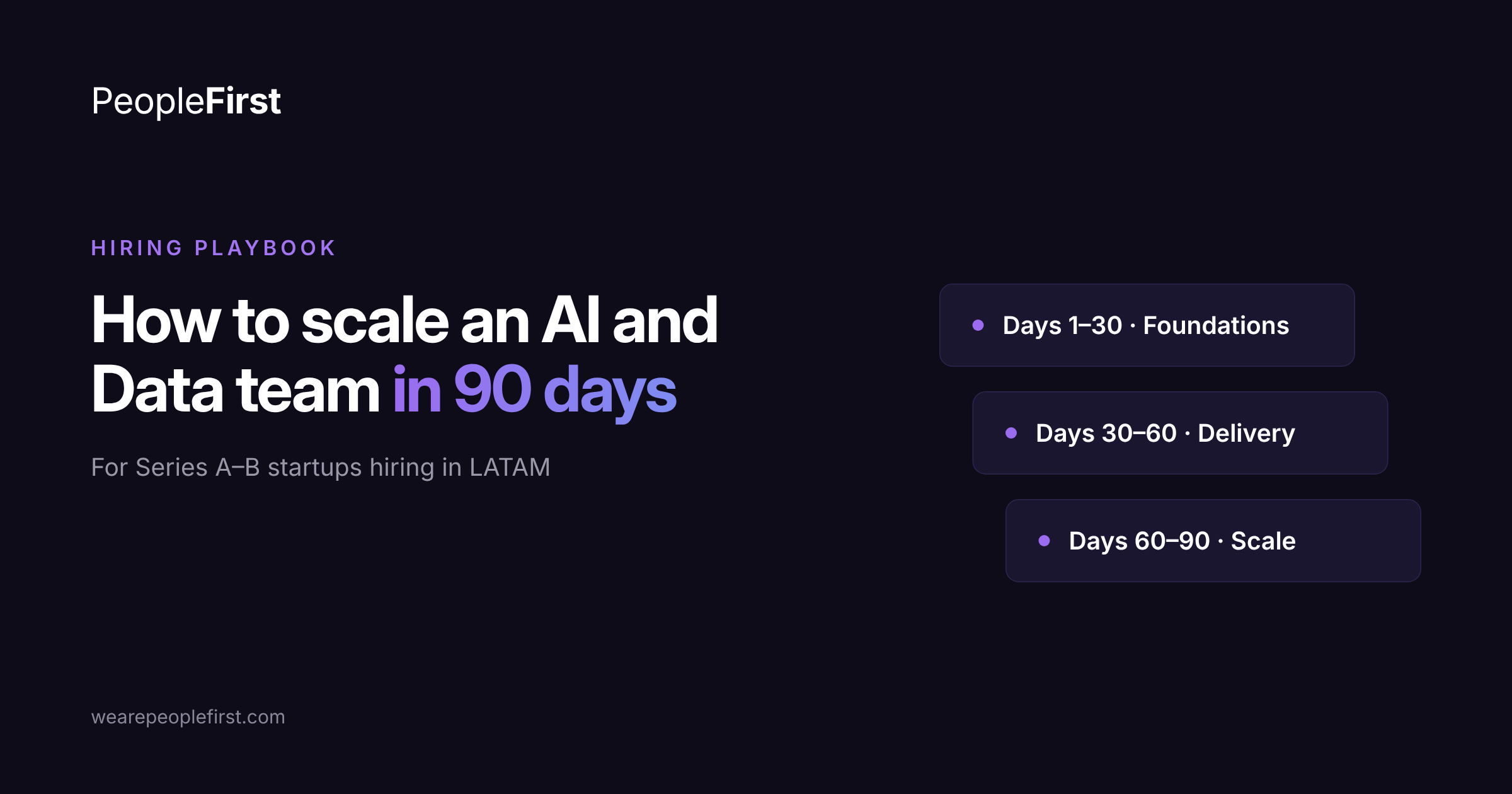
Wave 1 (days 1 to 30): the foundations
- Tech Lead or Senior Data/ML Engineer. This is the person who will interview everyone who comes after. If this hire fails, the whole plan fails.
- Senior Data Engineer. No reliable data, no models. This profile builds the foundation the entire team works on.
Wave 2 (days 30 to 60): delivery capacity
- ML Engineer or AI Engineer, depending on whether your focus is proprietary models or products built on LLMs.
- A second Data Engineer or an Analytics Engineer, if the business needs trustworthy metrics to make decisions.
Wave 3 (days 60 to 90): scale and specialization
- MLOps or Platform Engineer, once there are models to deploy and monitor.
- Mid-level profiles that your senior team can now mentor.
The logic is simple: first, the profiles that raise the bar for the next hires; then, the ones that multiply delivery capacity.
Realistic timelines by role
Planning with unrealistic timelines is the fastest way to frustrate your team and your board. These are indicative ranges for senior profiles in LATAM and USA, from opening the role to accepted offer:
- Senior Data Engineer: 4 to 6 weeks.
- Analytics Engineer: 3 to 5 weeks.
- Senior ML Engineer: 6 to 8 weeks.
- AI Engineer with LLMs in production: 6 to 10 weeks. This is the profile with the highest demand and the least real-world experience available.
- MLOps Engineer: 6 to 9 weeks.
- Tech Lead or Head of Data: 8 to 12 weeks.
On top of that, add the candidate's notice period, which in LATAM and USA is usually 2 to 3 weeks. If you need someone working by day 60, the search needs to start on day 1.
The interview process: fast doesn't mean shallow
When scaling, your hiring process becomes a bottleneck. These practices let you move fast without lowering the bar:
- 3 or 4 stages, max. Every extra stage adds a week and increases the risk of losing candidates who have other offers.
- Scorecards defined before interviewing. Each interviewer assesses specific competencies, not whether they "liked" the candidate.
- Feedback within 48 hours. Top AI and Data profiles get multiple offers at once. Response speed is part of your value proposition.
- Scoped technical exercises. An 8-hour take-home scares away senior candidates. A 60 to 90 minute live session on a real business problem gives you more signal and respects their time.
- Blocked interview slots. Reserve fixed time slots each week so your team doesn't have to rearrange everything every time a candidate moves forward.
The most common mistakes when scaling
Hiring for titles instead of problems. "We need a Data Scientist" means something very different at every company. Define the problem first, then look for the profile that solves it.
Lowering the bar because of urgency. A bad senior hire on a five-person team isn't a 20% error: it shapes the technical culture of everyone who joins after.
Ignoring onboarding. Hiring 8 people in 90 days without an onboarding plan creates a big team that takes months to become productive.
Overloading interviewers. If your CTO sits in 40 interviews in a month, the product stalls. Spread interviews across the team and train more people to assess candidates.
Not thinking about compensation from day one. Reaching the final stage with a candidate only to discover your salary band falls short is one of the most frustrating ways to lose weeks.
When to add an agency alongside your internal team
An internal Talent Acquisition team knows the culture and the business better than anyone. But when scaling fast, it often runs out of capacity, especially for niche profiles.
Bringing in an external partner makes sense when:
- You need to open more searches than your team can sustain without lowering quality.
- The profiles are niche, like AI Engineers with real production experience or MLOps, and require active sourcing of candidates who aren't looking.
- You're hiring in a new market and don't have a local network or salary benchmarks.
- You don't have a TA team yet and the founder or CTO is doing recruiting part-time.
The combination that tends to work best: the internal team leads generalist roles and the candidate experience, while the external partner focuses on the hardest profiles.
90-day checklist
- Week 0: 6-month goals defined, roles prioritized, salary bands approved, scorecards ready.
- Days 1 to 30: Tech Lead and Data Engineer searches open, interview process running, onboarding plan in place.
- Days 30 to 60: first hires starting, ML/AI Engineer searches open, senior team already joining interviews.
- Days 60 to 90: MLOps and mid-level profiles in process, review of what worked and adjustments for the next wave.
The bottom line
Scaling an AI and Data team in 90 days is possible, but it doesn't happen by opening every role at once and hoping for the best. It happens through clarity on the problem, a well-thought-out hiring sequence, an agile interview process, and realistic expectations about timelines.
Speed comes from planning, not from skipping steps.