Forward Deployed Engineers or FDE: the role everyone wants and almost no one can find
By Carla Costantini · September 29, 2026
A few days ago I was catching up with a former colleague, AI leader at a tech company. One line stuck with me: "companies are struggling to hire FDEs." It wasn't the first time I'd heard it. It's probably the fastest-growing role I've seen in the market this year.
What an FDE is
A Forward Deployed Engineer is a software engineer embedded with the customer. They don't build the product for every user. They take the product and make it work in production for one specific customer, with its data, systems and constraints.
Palantir created the role. Today OpenAI, Anthropic, Google Cloud, Stripe, Databricks and hundreds of AI startups are hiring for it. The reason is simple: models already work in the demo. The hard part now is making them work inside each company.
The demand, in numbers
- FDE postings were up roughly 729% year over year as of April 2026, according to an Indeed index reported by Business Insider.
- A Plank census counted 1,333 open roles across 565 companies on September 12, 2026.
- On Paraform, 59% of companies hiring FDEs are Seed to Series A. This isn't just a big tech story.
Why it's so hard to hire
Because it asks for three things that rarely come together:
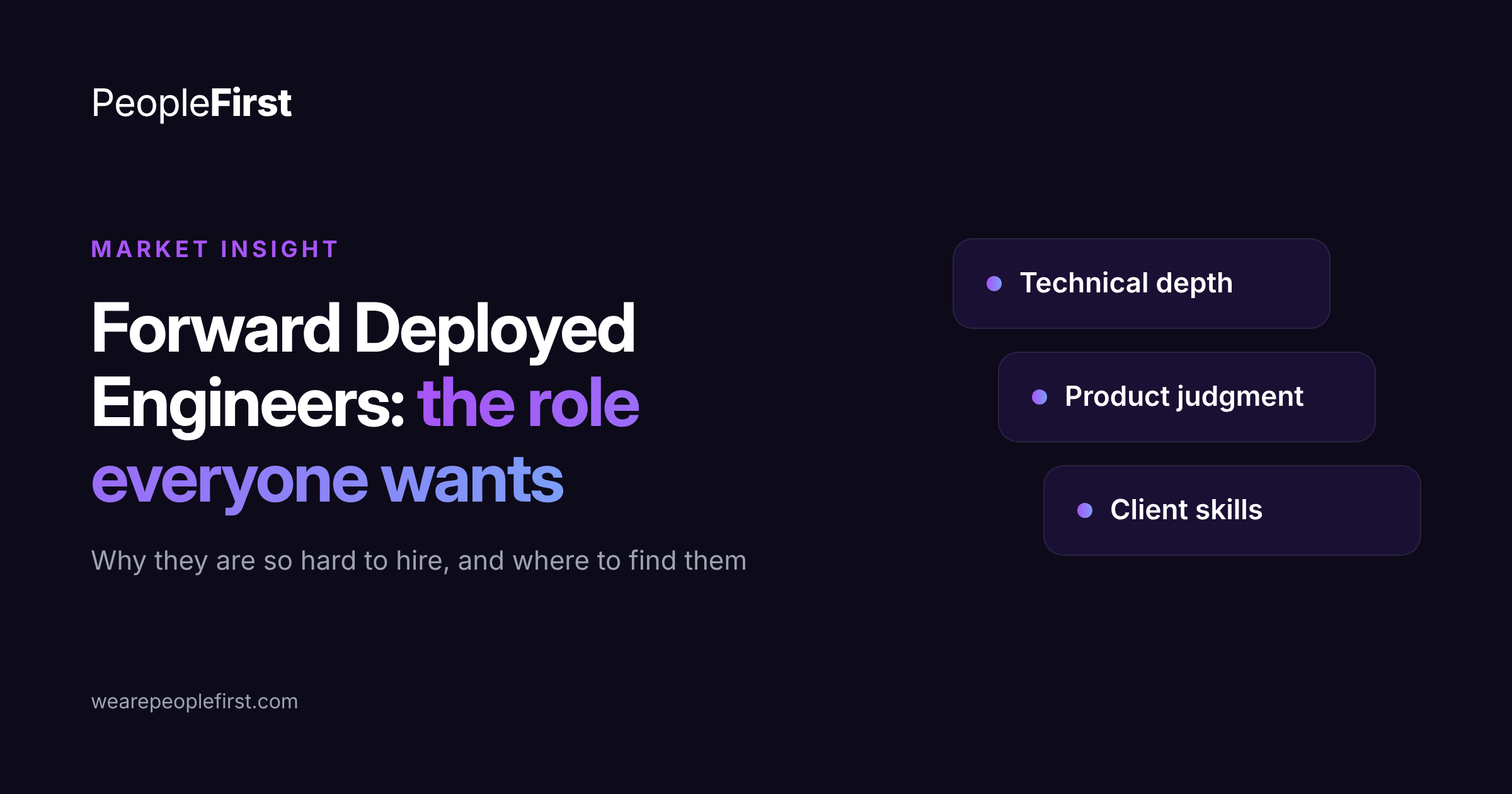
- Real technical depth: production code, integrations, data, and increasingly LLMs and agents.
- Product judgment: knowing which problem to solve, and which not to.
- Client skills: communication, scoping, comfort with ambiguity and, often, travel.
A great engineer who avoids customers won't work. A great commercial profile who can't code won't either.
The proxy that works
That same conversation gave me a very concrete shortcut: pair a strong technical foundation (Computer Science, Software Engineering or Systems Engineering) with consulting experience, for example at a global outsourcing or tech services company.
It makes sense. These are engineers who've already had to sit in front of a client and deliver. Add a top LATAM university and time at a leading global consulting firm, and you have the profile leading the market.
It's not a rule. It's a strong signal to start from.
The LATAM opportunity
LATAM has this profile at scale: engineers from demanding universities who spent years serving US and European clients from services companies. Add overlapping time zones, working English and competitive costs.
For a startup hiring its first FDE, looking in the region isn't plan B. Often it's the best place to find them.
Three tips before you hire one
- Define the role precisely. If it's really implementation or support, don't call it FDE. You'll attract candidates expecting something else.
- Assess both halves. A technical challenge and a client simulation. One isn't enough.
- Price in travel and context. If there's travel or on-site work, say so on day one and reflect it in the offer.
Let's talk
At PeopleFirst Talent Partners we recruit Engineering, Data and AI talent for startups and scale-ups across LATAM, the US and Europe. Opening your first FDE search? Reach out: wearepeoplefirst.com.
Sources: Deep Engineering (Indeed data via Business Insider) · Plank, FDE Job Market · Paraform · Uplers, 2026 FDE guide
Carla Costantini, Global Talent Partner at PeopleFirst Agency